
9/23/2026
How to Light and Keep Perfect Charcoal Embers in Your Barbecue
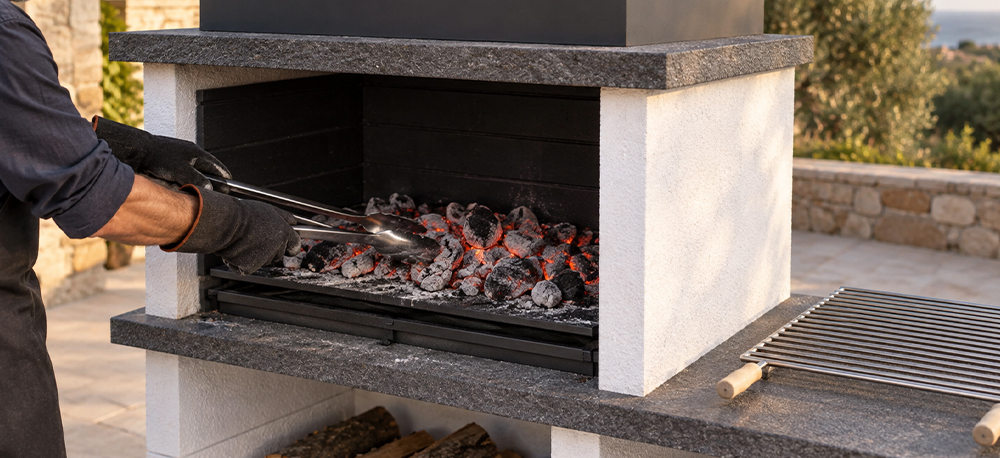
The best ember bed is not the one with the tallest flame. It is the one that holds a steady, even heat for the whole cook. You get there with dry fuel, air entering from below and patience: 20 to 30 minutes with charcoal, a little longer if you burn wood only. After that, keeping it alive is a matter of topping up early and in small amounts.
On a masonry paella grill all of that happens in the firebox before you start, because once the pan goes on, it stays there until the rice is done. What follows is written so you reach cooking time with the embers already settled, instead of watching the food wait for the fire to make up its mind.
What should you have ready before you light the barbecue?
Dry charcoal, a firelighter or paper and cardboard, long tongs, heat-resistant gloves and a long-nosed lighter. If you plan to mix in wood, two or three dry split logs. And a spot sheltered from the wind, which ruins more lighting attempts than anything else.
On quantity: a layer roughly 3 cm deep across the firebox covers a normal cook. Cooking for a crowd? Build more embers from the start instead of adding fuel mid-cook, because every top-up costs you around twenty minutes and a puff of white smoke.
How long do charcoal embers take to be ready?
20 to 30 minutes with charcoal, and 30 to 45 if you burn wood only, since logs first have to burn down before they turn into embers. Cold, damp air and wind stretch those times. Count from the moment you light, not from the first flame you see.
| Fuel | Roughly how long | Sign it is ready |
|---|---|---|
| Charcoal | 20-30 minutes | Lumps coated in grey ash with red underneath |
| Dry hardwood logs | 30-45 minutes | Logs broken down into embers, no flame |
| Charcoal plus one or two logs | 25-35 minutes | Even bed of ash with a few live spots |
| Embers lit separately (chimney starter or metal tin) | 15-20 minutes | Red on top, ash forming at the edges |
How do you light the embers, step by step?
The idea is to light part of the fuel and let it spread, with air moving underneath. Pile everything up and soak it in lighter fluid and you get a fast flame, poor embers and white smoke that ends up in the taste of the food.
- Lay a base of charcoal in the firebox. If you mix in wood, put the logs at the bottom and the charcoal around them.
- Leave gaps for air. Do not pack the charcoal flat against the bottom: draught has to pass between the pieces.
- Light the centre with a firelighter or with paper and cardboard. Never alcohol, petrol or solvents.
- Open the air vents and keep the ash drawer in place. Without draught the fire suffocates and takes twice as long.
- Don't stir anything for the first few minutes. The embers form on their own; stirring only lifts ash and smothers the small pieces.
- Once the top pieces are coated in grey ash, spread the pile with long tongs until you have an even layer.
How do you know the embers are ready?
Ready means fine grey ash with a red glow underneath. A flame means not yet. Black, glossy lumps mean not yet either. A good ember bed shows no fire at all: you feel constant heat and the food does not blacken the second it touches the grill.
| State of the embers | What it means | What to do |
|---|---|---|
| Tall flame, black fuel | The fuel is still burning, not yet giving embers | Wait; flame deposits soot on the food |
| Bright red, no ash | Very strong direct heat | Spread it out and give it a few minutes |
| Grey ash with red underneath | Cooking temperature | Start cooking |
| White ash, pieces falling apart | The embers are fading | Add fuel at the edge, never on top |
For a quick heat reading, hold an open hand at grill height without touching it: three or four seconds means strong heat, five or six medium, eight or more gentle. It is approximate, but it tells you whether to spread the embers further or wait a bit longer.
How do you keep the heat going through a long cook?
Top up early and in small amounts, at the edges. Wait until the heat drops and the new charcoal will need twenty minutes to give embers, releasing white smoke right under the food in the meantime. The comfortable way is to keep a batch already lit in a separate metal container and move it across with tongs.
- Add charcoal at the edge of the firebox before you need it, not once the heat has gone.
- Never drop fresh fuel underneath food that is half cooked. Light it first, place it second.
- Keep ash under control. Once the ash drawer fills up, the air intake chokes and the fire dies down without warning. Empty it before you start, and if you have to pull it out mid-cook, wear gloves and don't tip it.
- Move embers with long tongs, not by hand and not with a short stick.
- On a paella grill, spread the ember bed evenly from the start. You will not be able to rearrange it with the pan in place.
Charcoal, wood or both?
Charcoal lights quicker, gives more regular heat and is easier to control. Dry hardwood logs add aroma, but they smoke heavily at first and take a while to break down into embers. For a paella grill, a charcoal base with one or two logs gives you the best of both.
What you should not burn, even if it is sitting in the shed: treated, varnished or painted wood, chipboard, plywood and industrial pallets. The treatments and glues release compounds you don't want in the air or in your food. Damp wood is no good either. It smokes hard, gives less heat and dirties the grill faster.
How do you control the temperature without killing the fire?
With air and with distribution. More air coming in means more heat; closing the vents part way brings it down. A thin, spread-out layer gives gentle, even heat, while a heap concentrates the heat in one spot. Never shut the vents completely with a live fire inside.
Distance matters too. The further the food sits from the embers, the softer the heat arrives. And if it is a windy day, position the barbecue so the air does not blow straight into the firebox. Consumption shoots up and one side of the ember bed lights long before the other.
What changes when you cook on a masonry paella grill?
On a grill you can lift a steak and correct as you go. On a paella grill the pan stays where it is until the rice is finished, so the ember bed has to be right from the start: no cold patch and no single spot boiling away on its own. Build the layer wider and shallower than you would on a grill.
The Barbecue M3 is a masonry paella grill in artificial stone, 110 × 90 × 240 cm, with an iron firebox, an ash drawer and a stainless steel grill. The iron firebox helps protect the structure from direct exposure to heat, and the wide work surface lets you manage a long ember bed without rushing. Its price in the store is €2,060.
As a capacity reference, on the custom-made barbecues the standard firebox measures 68 × 45 cm, enough for a paella pan up to 50 cm across and around 14 servings. There is also an enlarged 80 × 60 cm version for 60-65 cm pans and roughly 25 servings. If you regularly cook for a crowd, check the spec of the exact model before deciding.
Common mistakes when lighting and keeping embers
- Using alcohol, petrol or solvents. Beyond the flash-fire risk, they leave a taste in the food.
- Cooking over flame. Flame doesn't cook better: it soots, smokes and sends the temperature all over the place.
- Heaping too much charcoal from the start. It suffocates, takes longer and then has to be spread in a hurry.
- Adding fresh charcoal directly under the food, white smoke included.
- Burning damp, treated or glued wood.
- Letting ash block the air intake and then blaming the charcoal.
- Lighting in full wind or with no shelter at all.
- Dousing the fire with water inside the structure.
How do you put it out and clean up?
Let the embers burn down. When you finish, close the air vents and don't throw water inside the barbecue: that sudden temperature change is hard on the stone, and wet ash sets like a crust. Wait at least 24 hours before emptying the drawer and cleaning.
- Remove the ash once it is completely cold and keep it in a metal container until you dispose of it.
- Clean the stainless steel grill while it is still warm, when grease comes off with the least effort.
- For the stone body, water and mild soap. No aggressive products and no pressure washer.
Start with embers, not flames
Build the ember bed in good time, top up at the edges and keep the ash from blocking the draught, and the rest of the cook largely takes care of itself. Rice shows it clearly: it wants heat that rises evenly across the whole surface, with no surprises halfway through.
You can see the full details of the Barbecue M3, with its measurements, finishes and price, in the store. And if you are not sure which model suits the size of pan you usually cook with, write to us and we will help you choose.